How to Make Your Logistics Company AI-Native
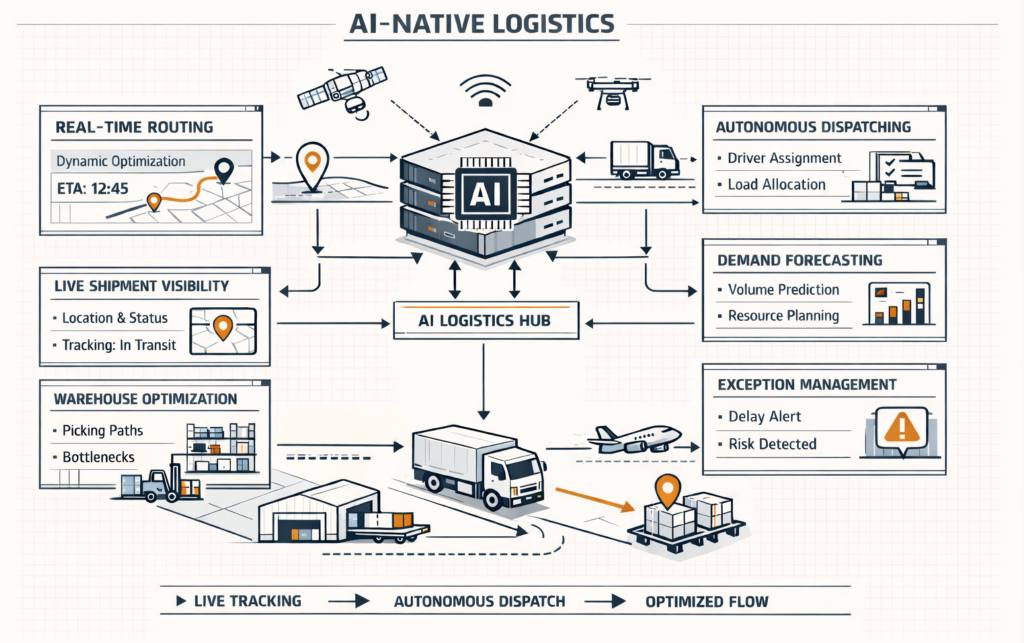
If your AI strategy starts with dashboards, tracking pages, or chatbots — you're not transforming logistics. You're just polishing the surface.
AI-native logistics is not about visibility. It's about control over flow.
Here's what actually needs to change.
1. MAKE ROUTING REAL-TIME
Stop planning routes once per day.
You need:
- Continuous route recalculation
- Inputs from traffic, delays, order changes
- Dynamic ETA updates
If your routes don't adapt every minute, you're still operating in the past.
2. BUILD FULL-CHAIN VISIBILITY
Tracking is not enough.
You need:
- Real-time location + status
- Unified data from vehicles, warehouse, and orders
- Predictive insights, not just current state
The goal is simple: know what will happen before it happens.
3. AUTOMATE DISPATCHING
Manual assignment does not scale.
You need:
- Dynamic driver and load allocation
- Constraint-based optimization (capacity, priority, SLA)
- Continuous rebalancing
Dispatching should run itself. Humans should only handle edge cases.
4. OPTIMIZE WAREHOUSE FLOW
Static processes kill speed.
You need:
- Adaptive picking paths
- Real-time bottleneck detection
- Synchronization with outbound logistics
Warehouse is not a storage unit. It's part of the flow.
5. SWITCH TO CONTINUOUS FORECASTING
Periodic planning is too slow.
You need:
- Live demand prediction
- Capacity planning in real time
- Automatic adjustments to resources
Planning should never stop.
6. BUILD EXCEPTION-FIRST OPERATIONS
Most companies react too late.
You need:
- Early anomaly detection
- Automated response scenarios
- Escalation only when required
If humans are discovering problems, your system is blind.
7. CHANGE THE ROLE OF PEOPLE
Your team should not move data.
They should:
- Monitor flows
- Approve AI decisions
- Handle exceptions
- Improve the system
If you implement all of this, you don't just optimize logistics.
You rebuild it.
That is AI-native logistics.