KAIZEN IS DEAD. At Least for the Next Decade.
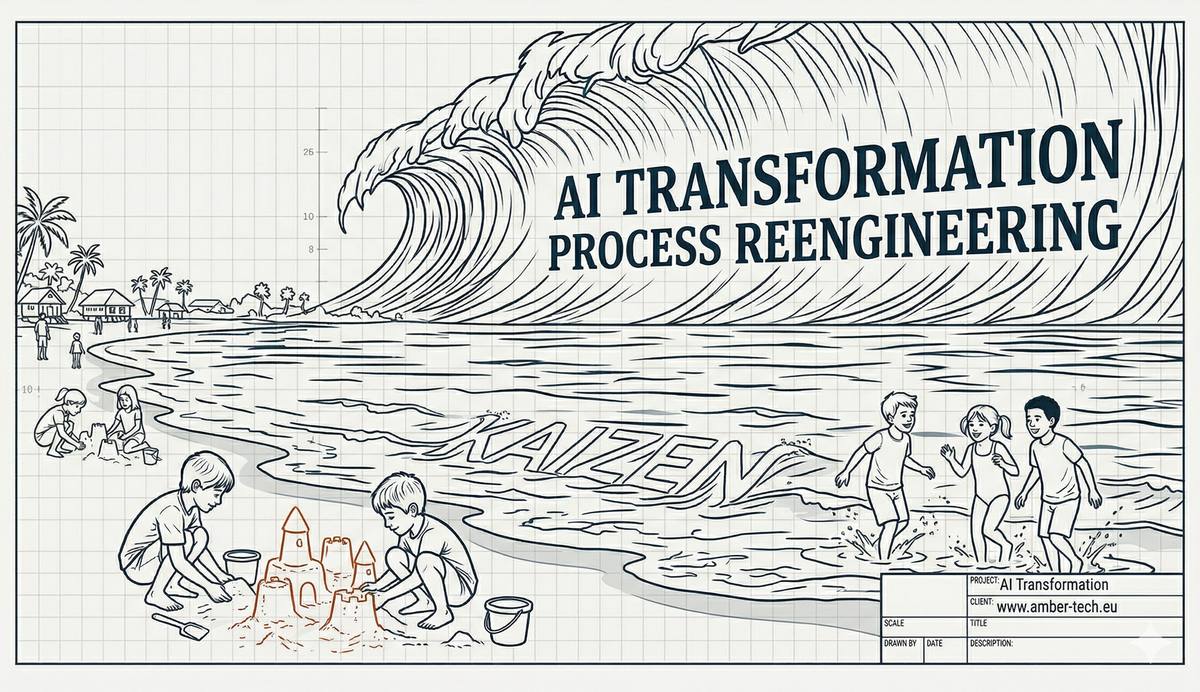
AI transformation is not an upgrade. It is a reset.
A growing number of companies are learning this the hard way. Adding AI on top of existing processes rarely delivers meaningful results. At best, it speeds things up slightly. At worst, it locks in inefficiencies that should have been removed.
The problem sits deeper. Most legacy processes were never designed for a world where decisions can be automated and knowledge is fluid. They are fragmented, siloed, and tied to assumptions that no longer hold. Trying to optimize them with AI is like reinforcing a structure that should be replaced.
There is a pattern here. In the 1990s, companies rebuilt processes from the ground up. Later, stability took over. From roughly 2005 to 2023, continuous improvement made sense. Systems were predictable enough to refine over time.
That stability is gone.
AI changes how work is done, not just how fast it happens. Decisions shift closer to data. Workflows collapse or merge. Roles evolve or disappear. In that environment, improving isolated steps becomes pointless. The logic of the whole system has changed.
You can see it in practice. The biggest gains don’t come from automating tasks. They come from redesigning how work flows end to end. Data, decisions, and people need to be reconnected in a different way.
Continuous improvement still has a place, but not at the start. It comes after the rebuild. First, you rethink the system. Then you refine it.
Many organizations struggle because they skip that first step. They launch initiative after initiative, each promising progress, none delivering real change. Over time, this creates fatigue rather than momentum.
The conclusion is straightforward.
Kaizen is not wrong. It is applied in the wrong phase.
In the AI era, incremental change cannot lead. It can only follow.
For now, advantage belongs to those willing to start over where it matters.