The Rise of Agentic AI: Why OpenClaw and NemoClaw Are Changing the Industry
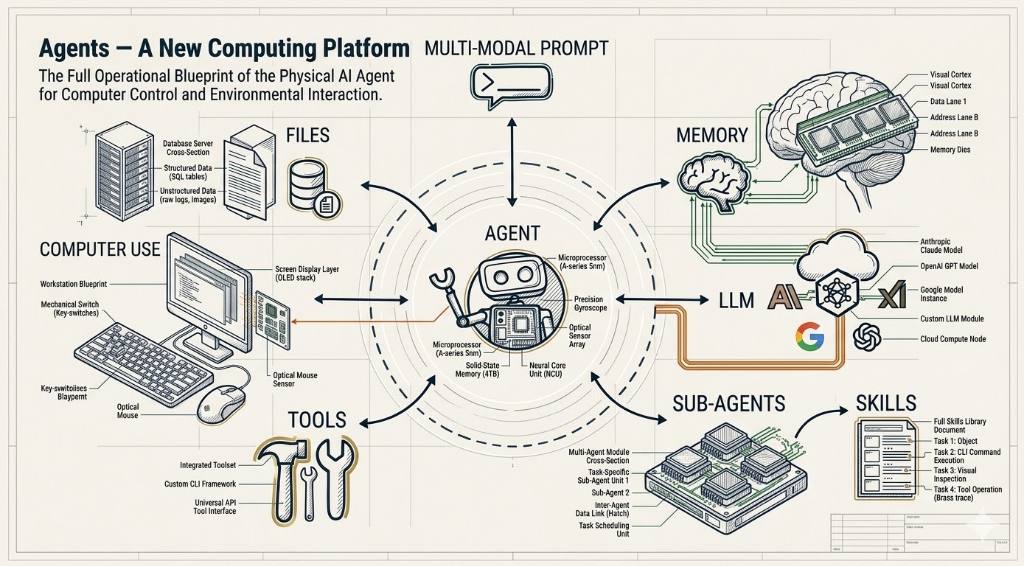
The world of information technology is entering another turning point. With the emergence of OpenClaw, an open platform for building autonomous AI agents, a new era is beginning. This shift can be compared to the arrival of Linux, HTML, or Kubernetes. This time, however, the change goes deeper. It affects not only infrastructure but also how humans interact with computers.
What is OpenClaw
OpenClaw is not just a tool or a library. It is essentially an operating system for agent-based computing. It allows developers to create autonomous AI agents that can perform tasks without constant human input.
The system brings together several key capabilities:
- Connection to large language models
- Resource and tool management
- Access to file systems
- Task scheduling
- Breaking complex tasks into step-by-step processes
- Coordination of sub-agents
- Multimodal interaction such as text, voice, and signals
In simple terms, OpenClaw turns AI from a passive tool into an active worker.
From Software to Agents
Traditional IT has always been built around software and data. Companies created tools that helped people perform tasks such as processing information, managing workflows, and storing data.
With agent-based systems, this model changes completely. Instead of tools, we now have digital workers. These agents can execute tasks on their own.
OpenClaw enables this transition. Just as operating systems once made personal computers possible, OpenClaw makes personal AI agents possible.
Why This Matters
The speed of OpenClaw’s adoption shows the scale of this shift. It has become one of the fastest-growing open-source projects ever. This signals that the industry is ready.
Each technological era had its foundation:
- HTML enabled the internet
- Linux powered server infrastructure
- Kubernetes enabled cloud computing
- OpenClaw enables agentic systems
Today, every company faces a new question. What is their strategy for agent-based AI?
NemoClaw: The Next Step
With new capabilities come new risks. Agent systems can access sensitive data, execute code, and communicate externally. This creates serious challenges for enterprise environments.
To address this, NVIDIA introduced NemoClaw. It is a reference stack that extends OpenClaw and prepares it for real-world business use.
NemoClaw adds:
- Security policies and control mechanisms
- Privacy-aware data routing
- Guardrails for safe execution
- Integration with enterprise systems
This allows companies to use agentic AI while maintaining safety and control.
A New IT Model
Agent systems are changing the structure of the IT industry.
Before:
- Companies built SaaS products
- Users interacted through interfaces
- Data was stored and processed centrally
Now:
- SaaS is evolving into Agent-as-a-Service
- Users delegate tasks to agents
- Agents operate autonomously
Software is no longer just a tool. It becomes an active participant in work.
The Token Economy
One interesting outcome of this shift is a new economic model. In the future, employees may receive token budgets to work with AI agents.
For example:
- An engineer receives a token allowance
- Uses it to increase productivity
- Achieves significantly better results
At the same time, companies will:
- Generate tokens through AI infrastructure
- Distribute them internally
- Sell them to customers
AI becomes a core production resource.
The Model Ecosystem
Another key element is the diversity of AI models. NVIDIA is building a large open ecosystem with millions of models across different domains:
- Language and communication
- Computer vision
- Biology and chemistry
- Physics and climate
- Autonomous systems
The idea is simple. One model cannot serve every industry effectively. The future belongs to specialized models that can be adapted to specific needs.
Sovereign AI
An important direction is the concept of sovereign AI. This allows countries and organizations to:
- Build their own models
- Control their data
- Adapt AI to local needs
This reduces dependency on global providers and increases technological independence.
A Renaissance of IT
All of these changes point to a major transformation of the industry. A market worth trillions of dollars today could grow significantly larger.
The reason is clear. Instead of tools, we now have intelligent agents that:
- Work faster
- Adapt to new situations
- Scale efficiently
This creates entirely new markets and business models.
Conclusion
The emergence of OpenClaw and NemoClaw is not just another technological update. It is a shift in paradigm.
We are moving:
- From software to agents
- From interfaces to autonomy
- From tools to digital workers
Just as the internet transformed communication and the cloud transformed infrastructure, agentic AI is transforming the nature of work itself.
The real question is no longer whether this transformation will happen. The question is who will adapt to it first.