AI native manufacturing: What NOT to Change First
Most AI content right now is just noise. My feed is packed with posts about AI making presentations, dashboards, chatbots, reports. Looks nice. Does almost nothing.
This is where most people go wrong.
What companies usually try first:
- HR and back office automation
- Management dashboards
- Chatbots for factory or departments
- Auto-generated presentations and reports
Sure, it helps. Saves time. Makes things a bit smoother. But this is not what makes a company AI-native.
If you actually want to rebuild operations, forget interfaces at the start. Focus on what really drives the system.
Because what happens next is predictable:
First, traditional companies lose to those experimenting with AI. Then those "in-between" players get crushed by real AI-native companies.
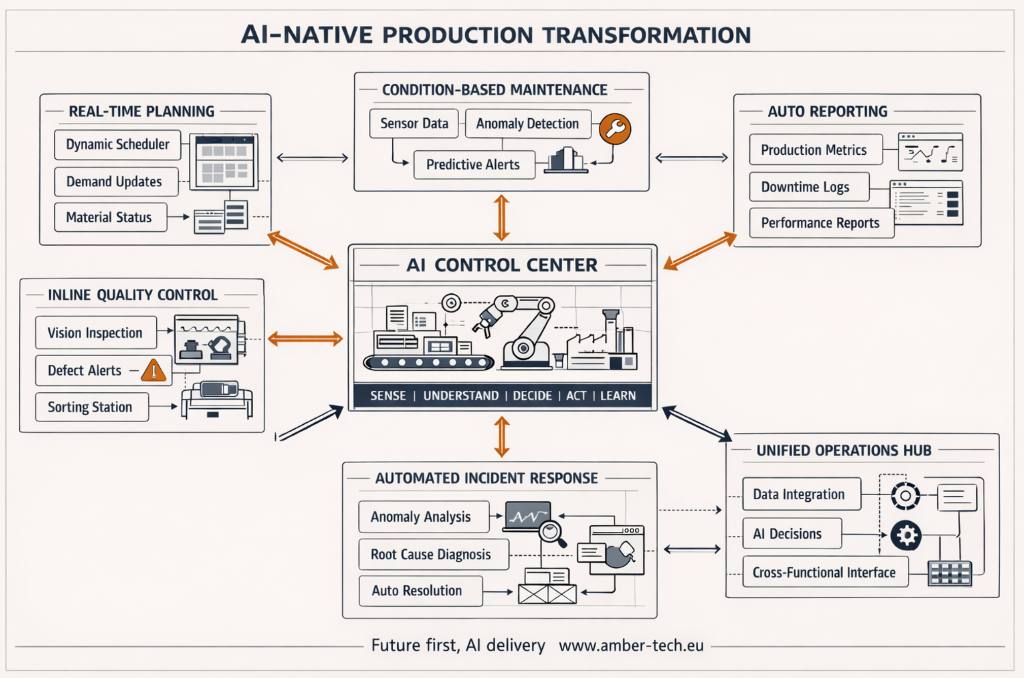
PLANNING
Old way: static plans for the day or shift, manual fixes, Excel, calls
AI-native: a living plan that constantly adjusts to reality — line load, missing materials, quality issues, broken machines, urgent orders
This is the core. Without it, everything else is decoration.
QUALITY CONTROL
Old way: sampling, checking after the fact, paper checklists, defect analysis later
AI-native: inline control — computer vision, real-time alerts, defect classification, instant reaction in both process and planning
The shift is simple: not we saw it, we'll fix it later — but we stop it immediately.
MAINTENANCE
Old way: by schedule or after something breaks
AI-native: based on real condition — sensors, anomaly detection, lifetime prediction, tasks triggered by risk
Real value appears when blind spots disappear and everything becomes visible in real time.
DEVIATIONS AND INCIDENTS
Old way: problem happens → operator reports → supervisor checks → engineer joins → solution comes hours or days later
AI-native: system detects the issue, gathers context, suggests causes, triggers actions, escalates only if needed
This is where AI stops being an analyst. It becomes the one running operations.
PRODUCTION REPORTING
Old way: manual, after shift, rewritten data, subjective explanations
AI-native: reports build themselves from machines, MES, ERP, SCADA, images, checklists, operator input
People don't write reports anymore. They just confirm exceptions.
SHOP FLOOR COORDINATION
Old way: silos — production, quality, warehouse, maintenance all separate
AI-native: one decision layer based on shared data
Not alignment in slides. Real alignment in decisions.
ROLE OF OPERATORS, SUPERVISORS, ENGINEERS
Old way: searching, comparing, moving data between systems
AI-native: supervising flows, approving recommendations, handling exceptions, improving the system
This is AI-native. Not another chatbot. Not another dashboard. Not another HR tool.